



 Voi cuts emission intensity by 83% since 2019 – reaching parity with public transport and private pedal bikes
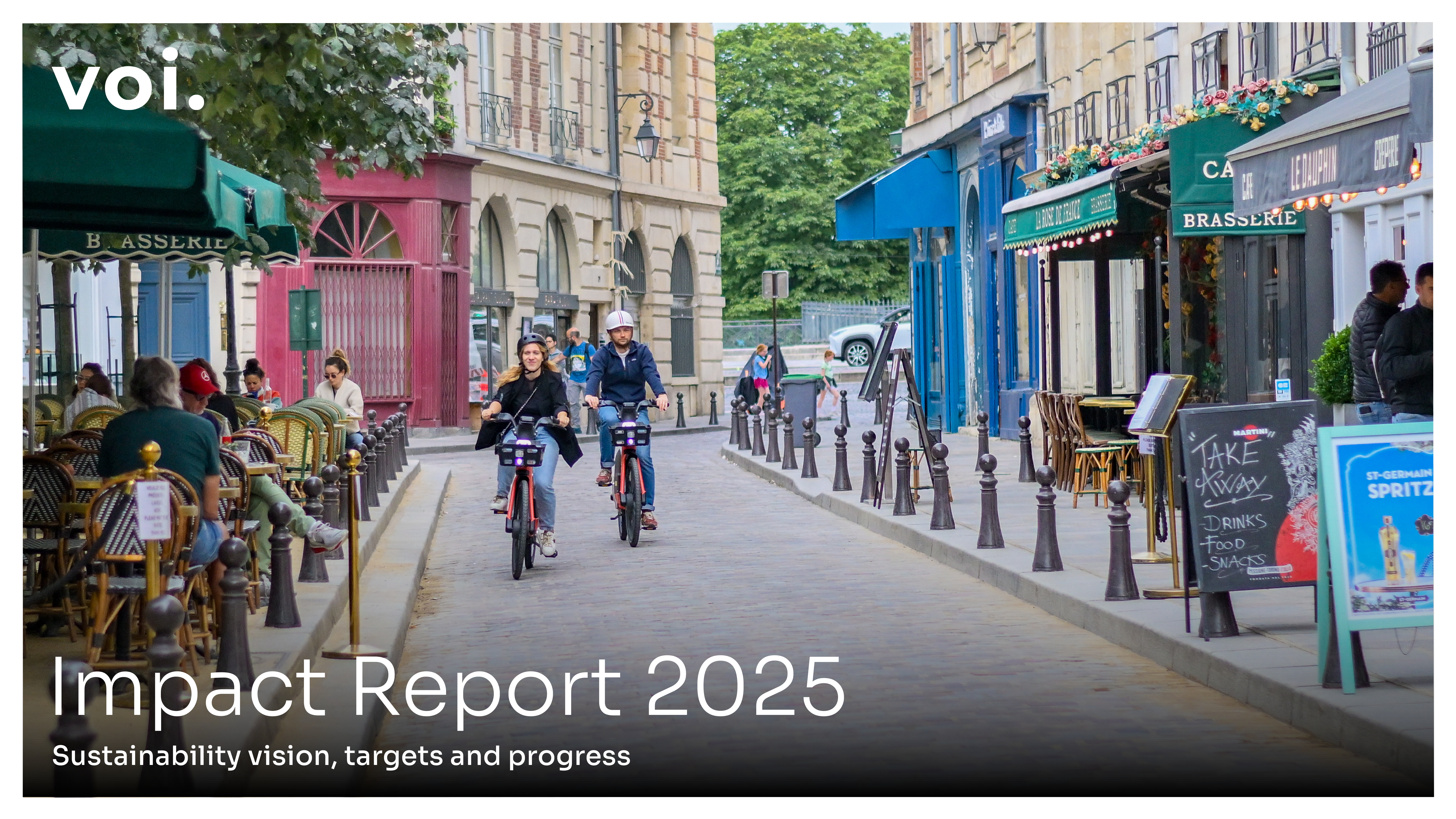 Voi Sustainability Report 2025 Cover

Voi cuts emission intensity by 83% since 2019 – reaching parity with public transport and private pedal bikes

Voi, Europe's leading shared micromobility operator, today published its 2025 Impact Report, marking a significant milestone in the company's journey toward genuinely low-carbon urban transport.
Since 2019, Voi has reduced its emission intensity by 83%, to 21-23 g CO2e per passenger kilometre today. That reduction – driven by increased recycled content in manufacturing, the introduction of renewable electricity in production, and longer vehicle lifespans – puts Voi's vehicles on a par with, and in many cities below, public transport.
How can shared micromobility have similar emissions per kilometer as cycling?
The report confirms that Voi vehicles produce emissions on par with private cycling, challenging the long-held assumption that the pedal bike is the gold standard of low-carbon travel. While bikes require no battery or motor, they run on food energy, which carries a measurable carbon cost. Voi vehicles, powered by renewable electricity and ridden far more frequently than privately owned bikes, spread their production footprint across significantly more kilometres, bringing their lifecycle emissions in line with one of the most iconic forms of green transport.
Highlights from Voi’s 2025 Impact Report
- Scope 1 and 2 emissions have been nearly eliminated (-53% versus already low 2024 levels) and now represent just 1.5% of total emissions.
- Vehicle emission intensity fell a further 30–34% compared with 2024, driven by increased recycled content (41% in scooters, 25–27% in bikes) and renewable electricity now used in 81% of scooter production.
- Vehicle emission intensity reached 21–23 g CO2e/pkm — on par with cycling
- 55 million trips (48% of all rides) were combined with public transport, reinforcing micromobility's role in integrated urban mobility.
- Car use as the primary mode of transport declined among Voi users, while micromobility and public transport increased.
- 12% of trips replaced car journeys, corresponding to approximately 14 million avoided car trips.
- Voi's vehicle and battery lifetimes remain industry-leading: a validated 15-year expected lifetime for shared vehicles and at least 10 years for batteries.
- Our circularity focus kept 97% of batteries in circulation in 2025.
- In 2025, Voi set a new transparency benchmark for the micromobility industry, publishing the first independently audited, CSRD-compliant sustainability report.
Fredrik Hjelm, CEO and co-founder of Voi, said:
“When we started Voi, we made a bet that shared micromobility could become genuinely low-carbon transport. Not just better than a car, but better than almost anything else on the road. Reaching parity with the pedal bike on lifecycle emission intensity is a moment we're proud of. But what matters most is what micromobility means for cities. When millions of people choose to move differently, cities change. Shared micromobility is quietly reshaping what urban life can feel like, and we're only getting started.”
Åsa Christiander, Head of Sustainability at Voi, said:
“An 83% reduction in emission intensity since 2019 doesn't happen by accident. The companies that will actually move the needle on urban emissions are the ones that treat sustainability as an engineering challenge, not a brand story. At Voi, it sits at the core of how we design vehicles, source materials, and think about longevity. That's not a value statement, it's a business model. And that's what lies behind the meaningful progress we report today.”
Read the full 2025 Impact Report here.