


 PDF
PDF
 File
File


Crunchfish Publishes Whitepaper: Rethinking Trust in Payments
Crunchfish today publishes its new whitepaper: Rethinking Trust in Payments, presenting a comprehensive framework for understanding how trust is represented in modern payment systems. The whitepaper identifies two independently configurable dimensions of payment architecture: monetary assurance and payment authority and introduces Trusted Intent as a new way to represent payment authority independently of the session in which it was created.
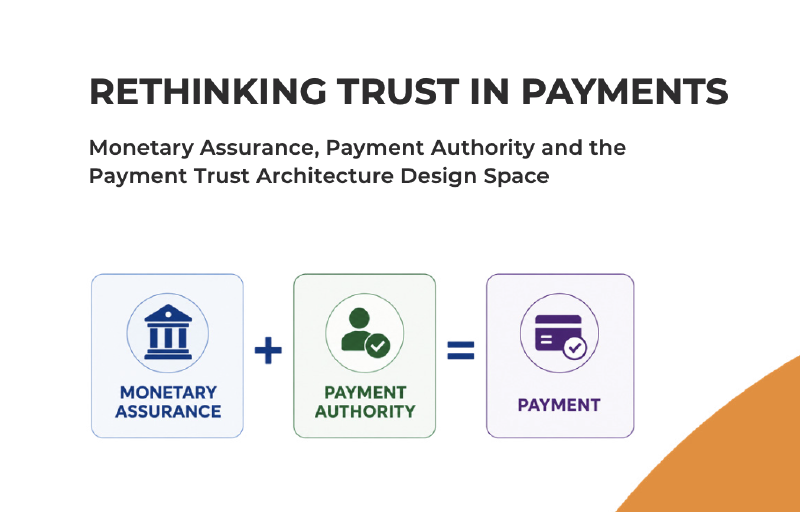
Every payment depends on two fundamental assurances. There must be assurance that money exists and can support the transaction: monetary assurance, and assurance that someone is authorised to initiate a change in monetary state: payment authority. The whitepaper argues that these two assurances should be treated as distinct architectural dimensions.
Monetary assurance may be represented through Trusted Assertions, where authoritative ledger records establish the existence of money, or through Trusted Objects, where monetary assurance is embedded in independently verifiable objects that can be held and transferred. Payment authority may similarly be represented through Trusted Sessions, where authority exists within an authenticated interaction with payment infrastructure, or through Trusted Intent, where payment authority is captured in an independently verifiable instruction that can be carried, verified and executed outside the originating session.
Together, these dimensions define a broader design space for payment architectures and provide a framework for understanding different forms of interoperability. System interoperability connects Trusted Sessions to Trusted Assertions across systems. Monetary interoperability arises when monetary assurance becomes portable through Trusted Objects. Transaction interoperability becomes possible when payment authority itself becomes portable through Trusted Intent.
"The central insight of this whitepaper is very simple: a payment requires both monetary assurance and payment authority. Payment architectures can therefore be understood through how each of these two assurances is represented," says Joachim Samuelsson, CEO of Crunchfish. "Money has developed increasingly portable representations. Trusted Intent shows that payment authority can undergo a similar architectural development. This opens a new design space for payments that extends well beyond offline payments."
From Governed Offline to Portable Trust
The framework has its practical origins in Crunchfish's work on Governed Offline payments. Governed Offline separates payment authority from the continuous availability of the underlying payment system. Monetary state, ledger authority and settlement remain with the existing payment infrastructure, while signed payment instructions can be created and exchanged locally under system-defined governance and constraints.
The whitepaper generalises this architectural separation through the concept of Portable Trust. Trusted Intent allows governed payment authority to become independently representable and verifiable, enabling payment activity to continue even when the originating session or infrastructure is no longer available. Governed Offline is therefore presented as the first practical implementation of a broader architectural principle. The same separation of payment authority from continuous infrastructure availability may have applications in delegated payments, programmable payments, AI-agent transactions, tokenised financial markets and future monetary systems.
Final whitepaper extends the July pre-print
Crunchfish released a pre-print of the whitepaper in July 2026 to invite review and feedback from payment professionals, central banks, regulators, academics, investors and other stakeholders. The pre-print introduced four trust models: Trusted Session, Trusted Assertion, Trusted Object and Trusted Intent, and proposed Portable Trust as the next evolution of payment architectures.
Following the review process, the final whitepaper develops the framework substantially further. Rather than treating the four trust models primarily as a sequential evolution, the final paper distinguishes two independent dimensions of trust:
Monetary assurance: Trusted Assertion → Trusted Object
Payment authority: Trusted Session → Trusted Intent
This distinction leads to a two-dimensional Payment Trust Architecture Design Space and clarifies how different architectural transitions enable system, monetary and transaction interoperability.
"The review process helped us sharpen the central idea considerably," says Joachim Samuelsson. "The pre-print asked what comes after Shared Trust. The final paper goes deeper by recognising that money and payment authority are separate things that can evolve independently. Trusted Intent is particularly important because it makes payment authority independently representable. We believe this provides a useful new framework for thinking about the future architecture of payments."
The whitepaper also analyses offline payment architectures as a practical test of the framework, discusses security and governance requirements for independently represented authority, and explores how the same architectural principles could apply beyond offline payments.
Rethinking Trust in Payments is available for download at https://www.crunchfish.com/wp-content/uploads/2026/08/Final-Version-Whitepaper-August-2026.pdf.
For more information, please contact:
Joachim Samuelsson, CEO of Crunchfish AB
+46 708 46 47 88
joachim.samuelsson@crunchfish.com
This information was provided by the above for publication on August 14th, 2026, at 08:30 CEST.
Västra Hamnen Corporate Finance AB is the Certified Adviser. Email: ca@vhcorp.se. Telephone +46 40 200 250.
About Crunchfish - crunchfish.com
Crunchfish is a deep fintech company developing governed offline payments technology for payment systems, banks, and payment applications. The company enables offline payments as a Layer-2 solution on top of existing payment systems, allowing transactions to be executed without connectivity while ledger authority and settlement remain unchanged. Through a reservation-based model, resilience is achieved without creating parallel forms of money or unmanaged credit risk. Crunchfish's architecture is patented and enables interoperability across multiple payment systems and markets. The solution strengthens system stability while also supporting economic incentives by ensuring that liquidity backing offline payments remains within the regulated financial system.