



 New Nordic study from Nepa: Never used an AI chatbot? For one in three “non-users”, AI is still part of the shopping journey
 Consumer Study 2026


New Nordic study from Nepa: Never used an AI chatbot? For one in three “non-users”, AI is still part of the shopping journey

More than one in three Swedes who have never used an AI chatbot still use the AI answers in Google when they search for products. AI therefore reaches far more people than those who describe themselves as active AI users. At the same time, use is growing fastest among older consumers: among Swedish Baby Boomers, weekly AI use has nearly tripled in a year. These are the findings of Nepa’s new study, The Nordic Consumer Decision Study 2026, based on responses from more than 3,100 consumers in Sweden, Denmark and Finland.
Google often shows AI answers at the top of its search results. 55 percent of Swedes use them when searching for products, either relying on them or reading them and checking against other sources. Almost one in four Swedes (23 percent) rely on them entirely, compared with 15 percent in Finland and Denmark.
The gap exists across the Nordics. Among those who have never used an AI chatbot, 36 percent in Sweden use the AI answers in Google, compared with 29 percent in Finland and 25 percent in Denmark. In total, almost one in four Nordic consumers (24 percent) use the AI answers without having used AI for shopping in the past three months.
Active AI use is also increasing. Half of Swedes have used AI for shopping or product research in the past three months, and weekly use of AI chatbots such as ChatGPT has risen from 30 to 46 percent in a year. This puts Sweden ahead of the rest of the Nordics, ahead of Denmark (41 percent) and Finland (33 percent).
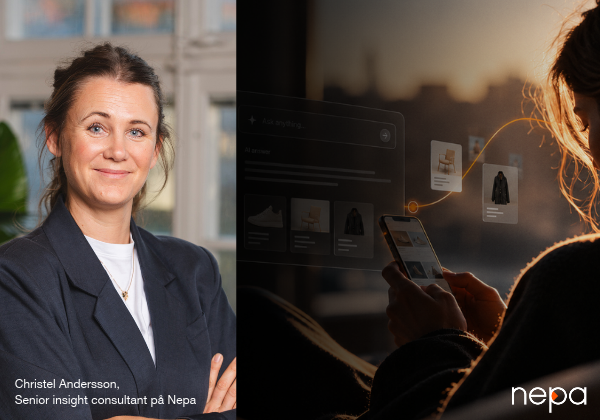
“Many people come across AI answers when they use Google, even if they have never opened an AI chatbot. This means that what AI says about a brand affects its visibility and its chances of being chosen, and with that, sales and growth. Being visible in AI answers is especially important for reaching new buyers, because people who are new to a category tend to look for more information than others. Brands therefore need to be clear about which needs they meet and in which situations, so that AI can suggest them in the right context,” says Christel Andersson, Senior Insight Consultant at Nepa.
Generation matters more than country
The increase is coming from older generations. Among Swedish Baby Boomers, weekly AI use has risen from 7 to 19 percent in a year, and in Finland from 9 to 21 percent. Swedish Gen X has made the biggest shift of any group, from 19 to 41 percent. But the gap to the youngest remains large: in Sweden, 62 percent of Gen Z use AI chatbots every week, compared with 19 percent of Baby Boomers. Between Sweden and Finland, the difference is just 13 percentage points.
“Many people still see AI in the shopping journey as something that concerns the young. But the biggest increases are now among older consumers, where use has more than doubled in a year. Generational differences are also bigger than differences between countries. Anyone who only targets their AI efforts at the youngest risks missing where change is happening fastest,” says Christel Andersson.
AI introduces new brands
This has clear consequences for brand owners. Half of Nordic AI shoppers had their brand choice influenced the last time they used AI to help them shop. In Sweden, 28 percent were recommended a different brand from the one they had planned to buy, and one in five (20 percent) bought a brand they had never heard of.
Read the full study in the report Age of Agency, where Nepa also describes six shifts marketing leaders need to make, including planning for AI-assisted buyers of every age: Age of Agency – Nordic Consumer Decision Study 2026 - Nepa
About the study
The Nordic Consumer Decision Study 2026 is a quantitative survey conducted in July 2026 among 3,137 consumers aged 16–74: 1,044 in Sweden, 1,055 in Denmark and 1,038 in Finland. Each national sample is representative by age and gender. The AI shopping measure covers the past three months and does not show the share of purchases made with AI help. Generations are defined as Gen Z 16–29, Millennials 30–45, Gen X 46–61 and Baby Boomers 62–74. Comparisons with 2025 are made where data is available, for Sweden and Finland.
For more information and interviews
Christel Andersson
Senior Insight Consultant, Nepa
christel.andersson@nepa.com
+46 73 619 72 79
Ulrika Berg
Marketing, Nepa
ulrika.berg@nepa.com
+46 72-568 77 08